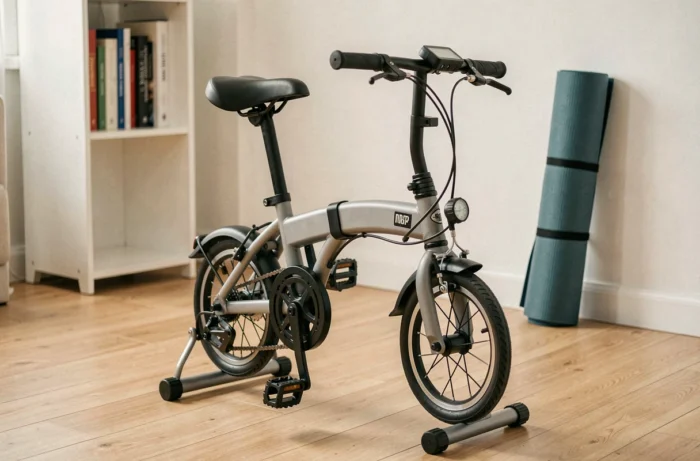
The entry-level folding exercise bike market remains dominated by a handful of familiar models, and the Ultrasport F-Bike 200B has been one of them for several years. Sold at a modest price and equipped with a backrest and pulse sensors built into the handlebars, this model is aimed at people with limited space and a tight budget.
Resale listings are plentiful on second-hand platforms, suggesting substantial sales volumes, but also a turnover rate that raises questions about how long buyers stick with it.
Maximum user weight and F-Bike 200B variants: conflicting figures
One detail rarely addressed in product descriptions is the maximum user weight the bike can support. Figures vary by source: some listings state 100 kg, others 110 kg, and a Spanish guide even mentions a variant rated for 130 kg. These discrepancies matter, especially for an overweight user looking to get active again.
The likely reason is that there are several F-Bike versions (150, 200B, 300B, 400BS), with slightly different specifications. Product details copied from one site to another sometimes include information for a different variant. Before buying, checking the manual and the label on the exact model is the only reliable way to confirm its actual weight limit.
A comparison compiling reviews of the Ultrasport F-Bike 200B can help cross-check user feedback on this issue, but it is no substitute for reading the manufacturer’s documentation.
Handlebar pulse sensors: an estimate, not medical monitoring
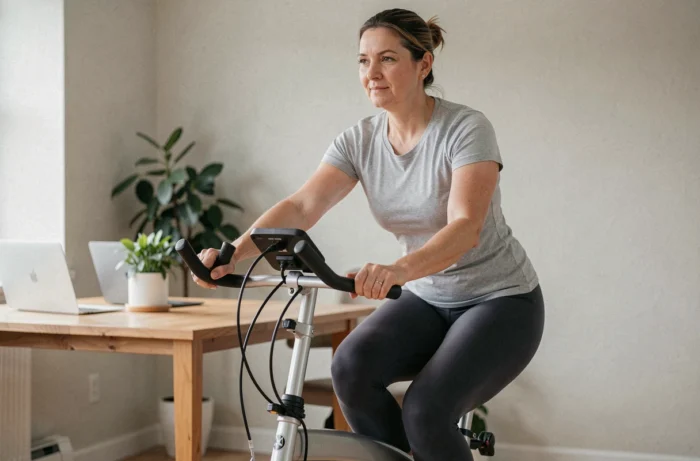
The F-Bike 200B has pulse sensors built into the handlebar grips. The console then displays your heart rate in real time. This feature is one of its selling points for people who want to monitor their effort, particularly when returning to exercise or undergoing rehabilitation.
A recent article points out that these sensors provide an estimate, not a medical-grade measurement. The technology used (contact sensors in the palms) is affected by grip pressure, sweaty hands and handlebar movement. Readings can differ significantly from those of a chest-strap heart rate monitor.
For someone following medical advice to stay within a specific exercise heart-rate zone (after a cardiac event or as part of functional rehabilitation), relying solely on the F-Bike 200B console display poses a real risk. The manufacturer does not claim that these sensors offer medical-grade accuracy.
What the console actually displays
The 200B’s LCD screen shows exercise time, speed, estimated calories, distance travelled and heart rate. These figures are calculated based on the selected resistance (eight manual levels) and pedalling cadence. Calorie estimates are only approximate, as they do not account for the user’s weight or basal metabolic rate.
In practice, the console serves as a visual motivator, not as a workout-planning tool. The eight magnetic resistance levels offer a limited range of effort, sufficient for light to moderate activity but quickly outgrown by regular athletes.
Saddle adjustment and body shape: an overlooked factor
Most descriptions of the F-Bike 200B mention its height-adjustable saddle. What they rarely specify is the actual adjustment range and whether it suits different body types.
One isolated user report suggests that saddle height may be an issue for taller users (around 1.80 metres and above). The backrest, presented as a comfort feature, also changes the position of the pelvis on the saddle and may increase discomfort if your inseam is not suited to the available adjustment range.
- Measure your inseam before buying and compare it with the minimum and maximum saddle heights listed in the manual for the exact model
- Check that the backrest does not force your pelvis into a position that is unsuitable for your body type, especially if you have lower back problems
- If possible, try sitting on the bike for several minutes before deciding to buy, as the comfort you feel in the first minute may not reflect how it feels after twenty minutes of pedalling
Folding exercise bikes and product compliance: what can and cannot be confirmed
Several buying guides describe the F-Bike 200B as compliant with current European standards, sometimes citing a CE mark. Safety, traceability and information requirements depend on the product type and the specific regulations that apply. Claiming that the 200B carries a CE mark without documentation for this specific model is an extrapolation.
This lack of clarity is not unique to Ultrasport. The low-cost online fitness equipment segment lacks transparency around certifications. For buyers, a manual in French, clear identification of the manufacturer or responsible importer, and an accessible after-sales service channel are more tangible indicators than a logo printed on a box.
Buying second-hand: extra precautions
The F-Bike 200B is frequently resold on private classified-ad platforms. In that case, the manufacturer’s warranty no longer applies, and it is difficult to assess the actual condition of the magnetic resistance, belt and folding mechanism from photos.
- Ask for the original manual to confirm the exact variant and maximum user weight
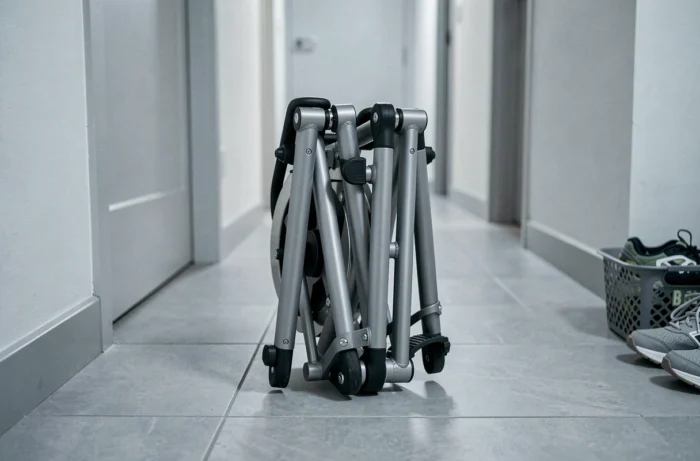
- Inspect the folding mechanism (play, squeaking, locking), which is the first structural component likely to wear out
- Check the condition of the drive belt, which is not always easy to replace on this type of equipment
The F-Bike 200B serves a specific purpose: providing light exercise in a small space at minimal cost. Its pulse sensors are no substitute for a medical device, its adjustment range does not suit every body type, and its resistance levels are quickly outgrown. If you are returning to exercise under medical supervision, it is better to seek professional advice on choosing equipment than to rely solely on a product description.