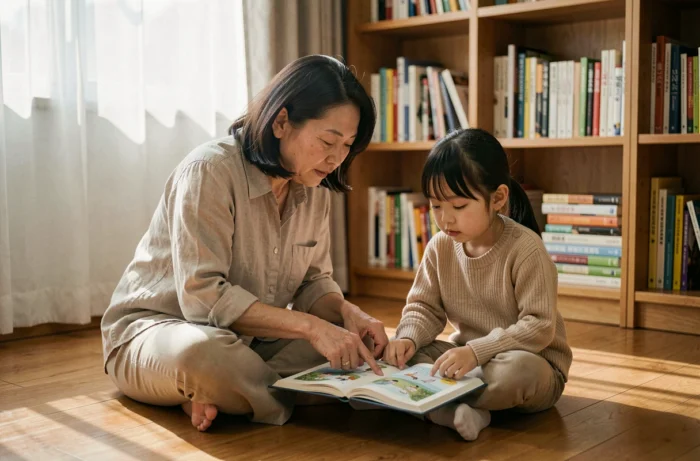
A three-year-old refuses to share his toy. You could tell him, “He who gives receives more,” from an old Chinese saying, and hope the lesson sinks in. In practice, the words go right over his head because they don’t match what he experiences or understands at that age.
Chinese proverbs about education carry a depth of meaning that deserves better than mechanical use. Their strength lies in their brevity, but their relevance depends on how they are used with a particular child in a specific situation.
Guidance or parental control: what proverbs don’t say
The proverb “The teacher opens the door; the student enters on their own” (师傅领进门,修行在个人) sums up a clear approach to guidance: show the way without taking over. In practice, the line between guiding and controlling can quickly blur, especially under academic pressure.
Recent research on Chinese families links differences in perceptions of parental psychological control to more depressive symptoms among adolescents. A parent who believes they are “showing the way” may, without meaning to, impose a rigid framework that the child experiences as surveillance. The proverb invites us to open the door, not push the child through it.
A collection of Chinese proverbs about educational wisdom highlights this distinction between passing on knowledge and imposing it—a distinction that remains at the heart of any lasting approach to education.
In China, the Family Education Promotion Law places parents’ educational responsibilities within a framework that goes beyond academic achievement alone: it encompasses the healthy development of minors and their overall support. Through a different route, this legislation echoes what the proverb expresses in vivid terms: guiding a child does not mean making decisions for them.
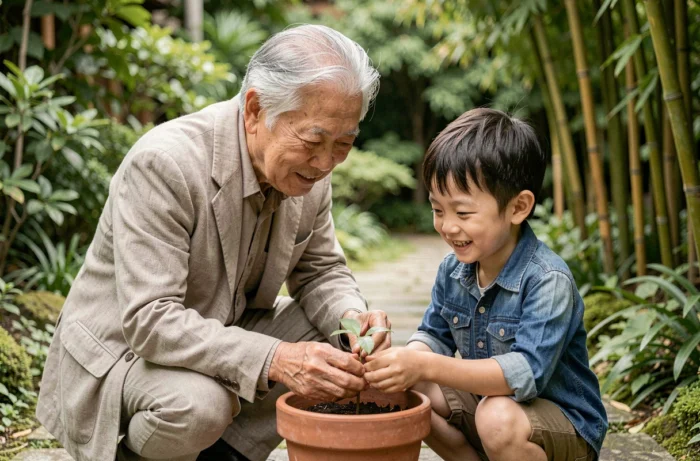
Adapting a Chinese proverb to a child’s age and temperament
“Learning is like climbing a mountain” (学如登山) works very well with a teenager who is feeling doubtful before an exam. With a five-year-old, the metaphor remains abstract. You don’t explain effort in the same way to a child just learning to read as you do to a middle schooler preparing for a math test.
Three factors that change a proverb’s impact
- Cognitive age: before the age of six or seven, concrete images (the mountain, the river, the tree) may be taken literally. Rephrasing the proverb with an example from the child’s everyday life makes it more relatable than simply quoting it.
- Temperament: an introverted child won’t respond to the same approach as an extroverted one. “Among three people walking together, there is always a teacher for me” (三人行,必有我师) celebrates learning from peers, but a shy child may take it as pressure to compare themselves with others.
- Need for autonomy: in the preteen years, repeating a proverb as a fixed rule invites resistance. It’s better to tell the story behind it or ask an open-ended question that lets the child work out the lesson for themselves.
The wisdom of the saying doesn’t change, but the way it is passed on should evolve with the child. A proverb shared at the right moment and in the right way leaves a lasting impression. Taken out of context, it rings hollow.
Academic pressure and proverbs about learning: finding a balance
The “Double Reduction” reform, adopted in China in 2021, aimed to reduce excessive homework and regulate private tutoring in compulsory education. A study published in 2024 reports that families have not all been able to adapt in the same way: spending on tutoring remains linked to socioeconomic status, and less advantaged families have been affected more.
This context sheds light on a paradox: proverbs such as “Learning has no end” (学无止境) encourage perseverance, but in an atmosphere of academic competition, they can fuel a race with no finish line. A reform doesn’t make the pressure disappear. It shifts it toward other family strategies.
For a French parent, the parallel is clear. Using a proverb about perseverance after a bad grade can encourage a child or, on the contrary, downplay their frustration. The difference comes down to one detail: acknowledge the emotion first, then share the proverb as a perspective, not as a disguised reproach.
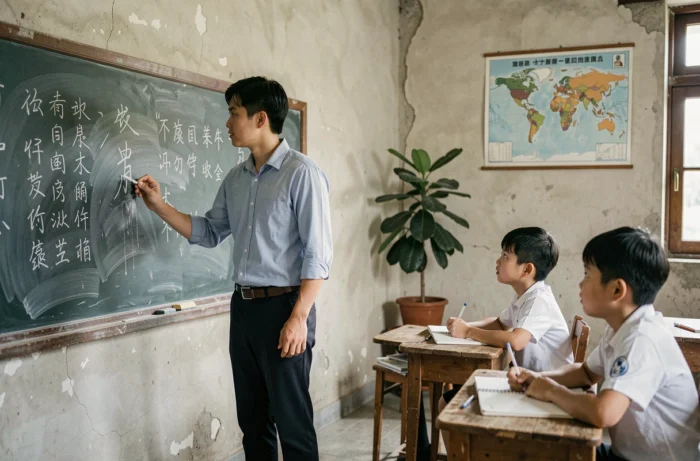
Chinese proverbs in everyday life: three real-life situations for parents
Rather than reciting one saying after another, it’s more effective to connect them to specific moments when they take on real meaning.
When a child struggles at school
“Fall seven times, get up eight.” You could put it this way to an eight-year-old: “Remember when you couldn’t ride your bike?” The idea behind the proverb comes through the child’s own experience, not as a pronouncement.
When siblings are fighting
“Patience is a tree whose root is bitter but whose fruit is very sweet.” When children are angry, the proverb can wait five minutes. First, defuse the conflict; then share the lesson, once they’re ready to listen again.
When you’re tempted to control everything
“Give a man a fish, and he’ll eat for a day. Teach him to fish, and he’ll eat for a lifetime” (授人以鱼不如授人以渔). This famous proverb about independence reminds parents that letting a child make mistakes is part of learning. Packing a ten-year-old’s schoolbag for them doesn’t help.
Passing on wisdom without making it rigid: wisdom as dialogue
A Chinese proverb is not an instruction manual. Its educational value depends on the relationship between adult and child, the moment it is shared, and the room left for interpretation. Families who use these sayings as a starting point for conversation rather than as a verdict find that children make the lesson their own instead of having it imposed on them.
Chinese wisdom about education has endured for centuries because it offers principles, not recipes. Keeping that flexibility when supporting a child day to day is precisely what the best proverbs teach between the lines.