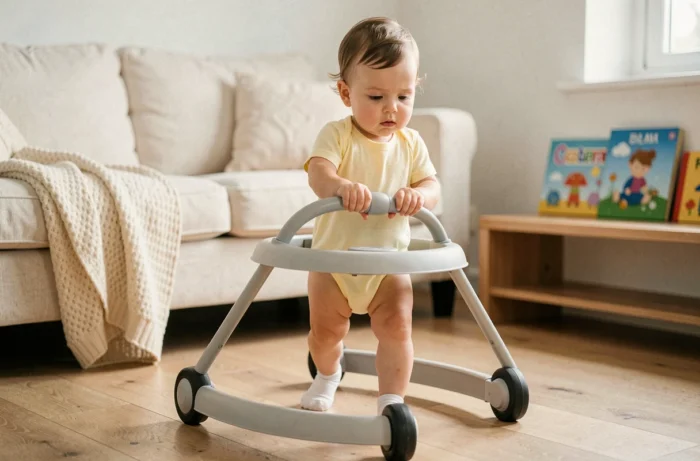
Choosing a baby walker means first answering a key question: does a wheeled device meet the child’s motor development needs at this particular stage? European standard EN 1273:2005 itself states that a baby walker is not a walking-learning device and that prolonged use may interfere with the natural development of motor skills. This distinction between regulatory compliance and real benefits for the child informs every other aspect of the decision.
Baby walker regulations: what the rules say in each country
The legal framework varies from country to country, and these differences shed more light on the debate than a simple comparison of models.
| Country | Status of wheeled baby walkers | Applicable standard or legislation |
|---|---|---|
| France | Sale permitted; use discouraged by Santé.fr (2023) | 2004 ministerial response, standard EN 1273:2005 |
| Canada | Sale prohibited since 2004 | Canada Consumer Product Safety Act |
| European Union (excluding France) | Sale permitted under standard EN 1273:2005 | EN 1273:2005 (including a caveat about learning to walk) |
In France, a 2004 ministerial response ruled out a ban, on the grounds that it would not prevent falls when children move around on their own. Canada took the opposite approach: banning baby walkers rather than reducing the risk through design standards. The catalogues available at youpala-bebe.fr list models that comply with the current European standard.
The Santé.fr guidance published in 2023 advises against baby walkers, including those that meet the standard. Regulatory compliance and health recommendations are two separate matters. A baby walker may be legal without being suitable for a child’s stage of motor development.
Baby walker, push toy or free movement: how to choose based on motor development
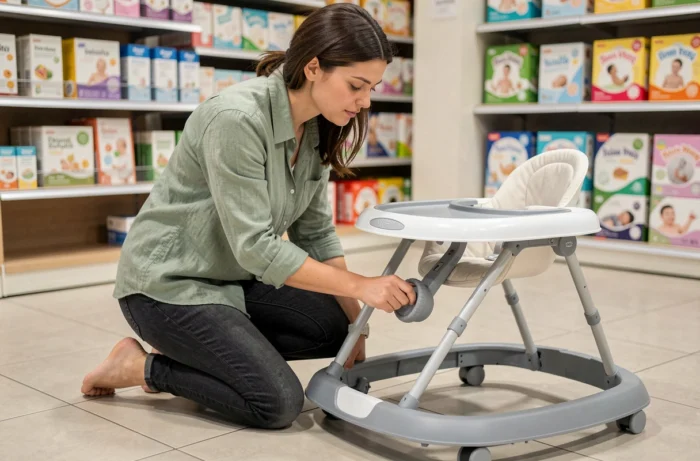
A traditional baby walker (circular frame, fabric seat and wheels) is intended for a child who can sit up unaided. A push toy, by contrast, is for a child who can already stand and is beginning to take steps while holding on. Confusing the two means offering a tool that does not match the baby’s actual stage of development.
When wheeled baby walkers can be a problem
In a baby walker, children move by pushing off with their toes. This posture does little to engage the stabilising muscles in the ankles and pelvis—the very muscles used when walking independently. The child moves forward without practising balance, which may delay the development of correct foot placement.
Documented accidents mainly involve falls down stairs, burns (from reaching hot surfaces that would normally be out of reach) and fingers getting caught in doors. A baby walker’s increased mobility expands the area of potential danger, even though the child may not yet have the motor skills to handle these situations.
What a suitable push toy can offer
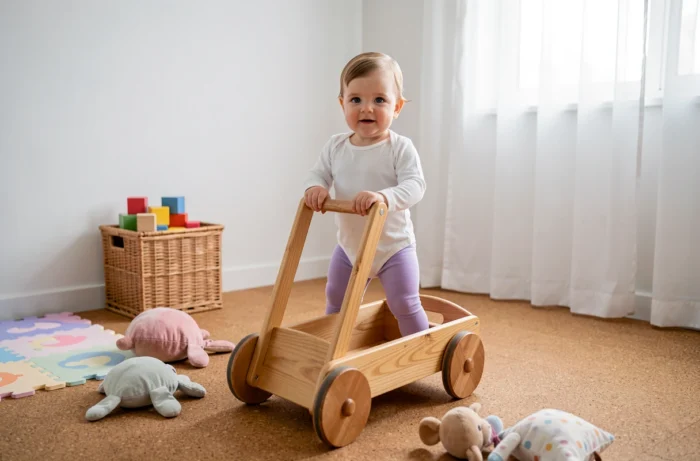
A weighted push toy allows a child who can already pull themselves up to progress at their own pace. Holding the handlebar helps guide their balance without supporting their body weight. The mechanical difference is clear:
- A baby walker supports some of the child’s weight through the seat, reducing the muscular effort required from the legs
- A push toy lets the child bear their full weight on their feet, with a simple point of support for balance
- Free movement on the floor (crawling, moving on all fours, pulling up on furniture) develops coordination and proprioception without any equipment
A push toy comes after crawling on all fours, not instead of it. It is best not to skip the natural sequence of motor milestones (rolling over, crawling, moving on all fours, pulling up, cruising sideways and taking first steps).
Baby walker safety: what standard EN 1273 requires
If you decide to buy a wheeled baby walker, there are several technical details worth checking carefully before you make a purchase.
- The base of the baby walker should be wider than its upper frame to reduce the risk of tipping over
- Non-slip pads or brakes should stop it moving on uneven surfaces or near changes in level (door thresholds, the edge of a step)
- The seat should support the child without pressing on the crotch or leaving their feet dangling without touching the floor
- Fasteners and rivets should have no protruding edges that the child can reach
A second-hand baby walker needs to be checked separately: inspect the wheels for wear, check the seat seams are intact, and make sure the model has not been recalled. Standard EN 1273:2005 only guarantees compliance when the product is placed on the market—not after several years of use.
How long and how often should a baby use a walker?
How long a baby walker is used is often an underestimated factor. Recommendations generally favour short sessions, rather than letting the child spend most of their waking hours in it. A baby walker should be used occasionally, not as the child’s main way of getting around.
A few practical guidelines: the child should be able to place their feet flat on the floor (not just their toes); the surface should be level and clear; and access to stairs, the cooker and heavy objects should be physically blocked off. Safety gates at access points are the only reliable way to restrict the area.
The choice between a baby walker, a push toy and free movement depends on the child’s actual stage of motor development, not their age in months. A baby who cannot yet sit up unaided has no use for a wheeled walker. A child who is already pulling up on furniture is more likely to benefit from a push toy or a safe space on the floor. The best way to choose is to observe what the child can already do, rather than what you would like them to be able to do.