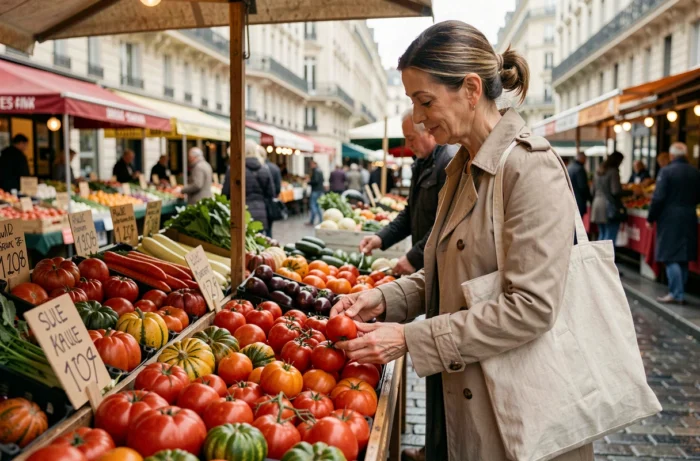
Paris has more than 80 food markets, open according to varying schedules from one neighborhood to another. All feature colorful stalls of fruits, vegetables, cheeses, and fish. But behind the uniform appearance, the actual source of the products varies significantly from one stand to another: a vendor at a Parisian market may resell lots purchased from Rungis with no connection to a local farm.
Distinguishing a reseller from a producer, understanding what the terms “organic” and “local” mean, identifying the markets where direct sales truly exist: this is what changes the quality of a basket.
Producer, reseller, local: what market labels don’t tell you
The word “local” does not guarantee the origin of the products. At a public market, a vendor can be labeled as local because their business is registered in Île-de-France, even if their fruits and vegetables come from Spain or Morocco. The only way to clear up any doubt is to ask directly: where was this product grown or raised, and by whom?
A direct sales producer grows or processes what they sell themselves. They can name their farm, specify its location, and describe their methods. A reseller, even if located at the same market, buys in bulk and redistributes. Both coexist at most Parisian markets without any obvious visual distinction.
The term “organic” follows a specific regulatory framework, with certification and controls. It does not imply that the seller is a producer, nor that the product comes from Île-de-France. A stand may offer imported organic tomatoes.
Conversely, a farmer in Île-de-France transitioning to organic may not yet carry the label. Cross-referencing this information at the time of purchase is part of the process, and several Parisian markets facilitate this transparency better than others, as detailed by the essentials from Paris Tribu on the subject.
Batignolles Organic Market: the only fully organic market in Paris
The Batignolles Organic Market, in the 17th arrondissement, stands out by a simple criterion: all the stalls offer products from certified organic farming. This is not a classic market with a few organic stalls scattered among conventional resellers. The entire offering meets the organic specifications.
This homogeneity simplifies the purchasing process. There’s no need to spot labels stall by stall or to systematically ask for confirmation. The market takes place on Saturday mornings, on Boulevard des Batignolles, near the Rome metro station.
For those specifically looking for organic without prior sorting, this is the most straightforward market in the capital. Other Parisian markets mix organic and conventional stalls, which requires more attention.
Enfants-Rouges Market: spotting producer days
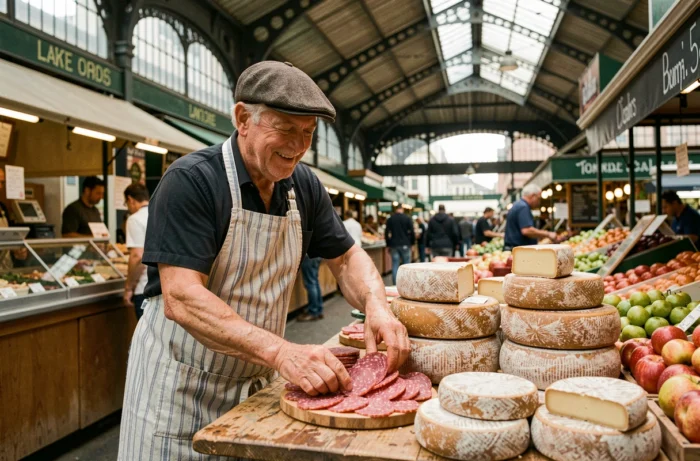
The covered market of Enfants-Rouges, in the 3rd arrondissement, is often cited as the oldest market in Paris. Its reputation attracts both local residents and visitors, and the offering oscillates between food stalls and fresh produce stands.
Producers are not present every day. Direct sales stands are indicated on Wednesdays and Saturday mornings, while the market also opens outside these slots. Therefore, coming on a Tuesday or Thursday does not guarantee finding a farmer selling their own harvest.
This distinction between market days and producer days applies to other Parisian markets. The hours published by the City of Paris indicate opening times, not the exact composition of the stalls. For a visit focused on direct sales, it’s better to inquire with the market or producer associations before going.
Check the origin on-site: good reflexes
- Ask for the name and location of the farm. A direct sales producer will respond without hesitation and often provide the name of a specific town in Île-de-France or a neighboring region.
- Observe the range of products. A stand offering dozens of varieties of fruits and vegetables year-round is likely a reseller. A producer offers a limited and seasonal range.
- Look for signs indicating “producer” or “direct sales.” Some markets, like Batignolles, display this information. In others, it’s up to the customer to ask the question.
- Check for the AB logo or the European organic logo (green leaf) if organic is claimed. The absence of a logo on a stall claiming to be organic warrants a follow-up question.
Bastille Market and Aligre Market: two different approaches to fresh products
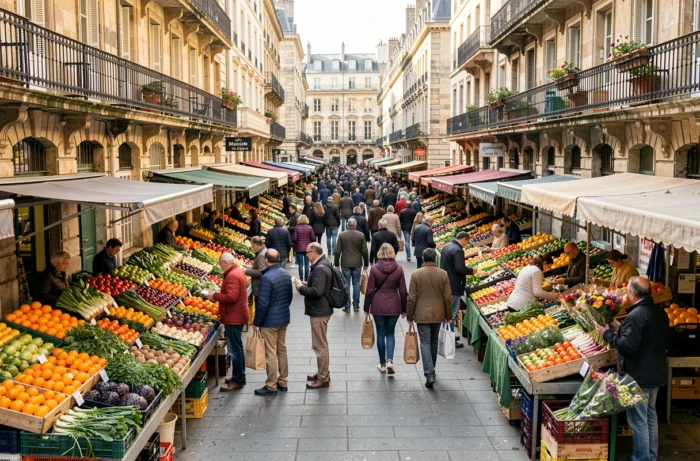
The Bastille market, which stretches along Boulevard Richard-Lenoir in the 11th arrondissement, is one of the largest outdoor markets in Paris. The offering is vast, with dozens of stands for greengrocers, fishmongers, cheesemongers, and butchers. The size of the market implies a significant proportion of resellers, but a few producers regularly hold stalls there.
The Aligre market, in the 12th arrondissement, combines a covered market (Beauvau) and an outdoor market in the Place d’Aligre. The atmosphere is more popular, and prices are often more accessible. The covered market houses specialized merchants (cheesemongers, charcutiers), some of whom work in short supply chains.
The difference between these two markets illustrates a point often overlooked: the size of a market does not predict the share of direct sales. A small market with three identified producers sometimes offers more reliable access to local products than a large, well-known market dominated by resellers.
Choosing your Parisian market based on what you really seek
| Criterion | Recommended Market | Details |
|---|---|---|
| 100% certified organic | Batignolles (17th) | Saturday morning, Boulevard des Batignolles |
| Direct sales from producer | Enfants-Rouges (3rd) | Wednesday and Saturday mornings for producers |
| Wide selection and varied prices | Bastille (11th) | Thursday and Sunday mornings, Boulevard Richard-Lenoir |
| Popular and covered market | Aligre (12th) | Place d’Aligre, covered market Beauvau |
A Parisian market remains a mixed commercial space, not an agricultural cooperative. The presence of a producer at a stall does not transform the entire market into a short supply chain. Spotting the days of presence, asking a few questions about the origin, distinguishing organic labels from mere freshness: these reflexes significantly change what ends up in the basket.