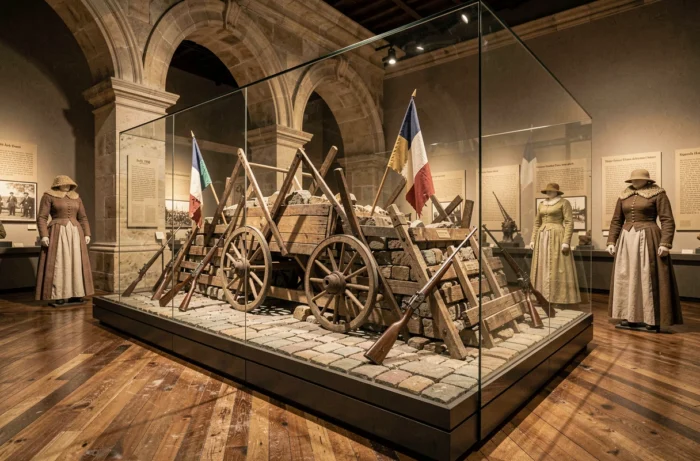
The Three Glorious Days refer to the insurrectionary events of 27, 28 and 29 July 1830 in Paris. In just three days, the Bourbon Restoration collapsed under the combined pressure of popular barricades and liberal opposition. Charles X abdicated, and Louis-Philippe of Orléans ascended the throne under an unprecedented title: “King of the French.” The episode marked a turning point in French political history, as well as a moment of constitutional tension whose effects spread far beyond France’s borders.
Article 14 of the Charter of 1814: the legal issue behind the Saint-Cloud ordinances
Most accounts of the Three Glorious Days focus on the economic and social context, the harvest crisis or rising unemployment in the textile industry. These factors mattered, but the immediate trigger was a dispute over constitutional interpretation. Charles X invoked Article 14 of the Charter of 1814, which authorized the king to take measures to ensure the “security of the state,” to justify the four ordinances published on 26 July 1830.
These ordinances did more than restrict freedom of the press. They dissolved the newly elected Chamber of Deputies, changed the electoral system and encroached on matters that fell within the legislative power, not the royal prerogative. Article 14, conceived as an emergency clause, became an instrument of a coup. For liberals and some legal scholars of the time, this interpretation was unconstitutional.
This had direct consequences for what followed: when the revised Charter of 1830 was adopted after Louis-Philippe’s accession, it explicitly prohibited the king from suspending laws or exempting anyone from their enforcement. Before it became an armed insurrection, the July 1830 crisis was first and foremost a struggle over the limits of monarchical power as set out in a constitutional text.
To learn more about the 1830 Revolution and the abdication of Charles X, the political sequence leading from the ordinances to the fall of the regime sheds light on the institutional dynamics at play.

Barricades in July 1830: three days, two sides, one balance of power
On 27 July, the first barricades appeared in the eastern districts of Paris. Printers, directly targeted by the reinstated censorship, were among the first to take to the streets. Students, workers and artisans joined them.
On 28 July, the insurrection spread. The royal troops, commanded by Marshal Marmont, struggled to control a city whose layout (narrow streets and dense buildings) favored the insurgents. The tricolor flag replaced the white flag on several public buildings, including the Hôtel de Ville.
On 29 July, the military situation turned. Units of the Royal Guard refused to fire. Charles X, having retreated to Saint-Cloud, lost all control over the capital. Liberal deputies, led by figures such as La Fayette and Thiers, organized the political transition by proposing the Duke of Orléans as lieutenant general of the kingdom.
The pivotal role of the liberal deputies
The insurrection was popular, but its political appropriation was the work of the liberal bourgeoisie. The 221 deputies who had voted for the address of no confidence in the Polignac ministry as early as March 1830 formed the core of the parliamentary opposition. They channeled the revolt toward a constitutional monarchical solution, ruling out both a return to the Republic and the continuation of Charles X’s regime.
This choice was far from inevitable. Some of the barricade fighters hoped for a republican regime. The speed with which the liberals installed Louis-Philippe was specifically intended to forestall that possibility.
The July Monarchy and the Charter of 1830: what changed and what remained
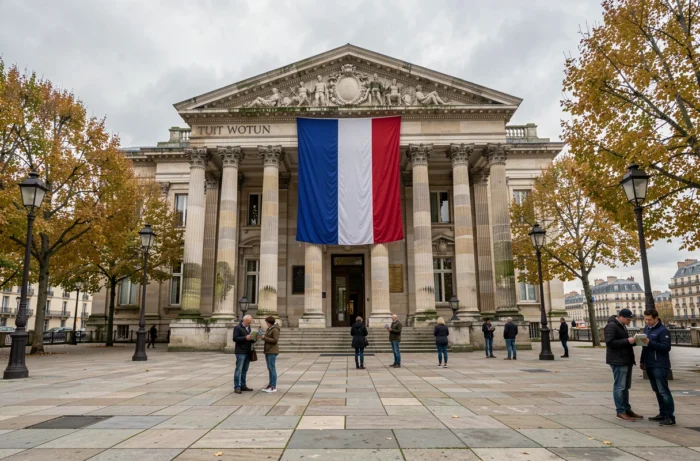
Louis-Philippe swore an oath to the revised Charter on 9 August 1830. The most visible change was symbolic: the sovereign was no longer “King of France” by divine right, but “King of the French” by the will of the nation. The tricolor flag once again became the official emblem, replacing the Bourbons’ white flag.
In substance, the Charter of 1830 introduced several concrete changes:
- The king was prohibited from suspending or amending laws by ordinance, a direct response to the Article 14 crisis.
- The property qualification for voting was lowered, expanding the electorate without introducing universal suffrage.
- Freedom of the press was restored and prior censorship abolished.
- Catholicism lost its status as the state religion, replaced by the designation of the religion “professed by the majority of the French.”
These advances nevertheless remained limited. Suffrage remained restricted by property qualifications, excluding the vast majority of the population from voting. The July Monarchy satisfied the liberal bourgeoisie but left out the workers and artisans who had built the barricades. This gap between symbolic rupture and continued political exclusion would fuel protests in the decades that followed, culminating in the Revolution of 1848.
European consequences of the Three Glorious Days: the case of Belgium
The events of July 1830 in Paris did not remain confined to France. Their shock waves reached several European countries, but the most tangible consequences were felt in Belgium.
As early as August 1830, Brussels rose up against Dutch rule. On 4 October 1830, Belgian representatives proclaimed the country’s independence. The close timing and shared context (rejection of a power perceived as authoritarian and liberal aspirations) created a direct parallel. The difference lay in the outcome: while France changed monarchs without changing its institutional form, Belgium created a new state with a parliamentary constitution considered at the time one of the most liberal in Europe.
Insurrectionary movements also broke out in Poland, Italy and some German states. Their outcomes were more mixed: the Polish uprising of November 1830 was crushed by Russia, while the Italian revolts were contained by Austria. The wave of 1830 reshaped Europe’s political map unevenly, depending on the ability of conservative powers to preserve the order established by the Congress of Vienna.
The Three Glorious Days lasted only three days, but they raised a question that would run throughout 19th-century France: how to reconcile popular sovereignty with the exercise of power without slipping back into authoritarianism. The solution adopted in 1830—a bourgeois parliamentary monarchy—lasted only eighteen years.