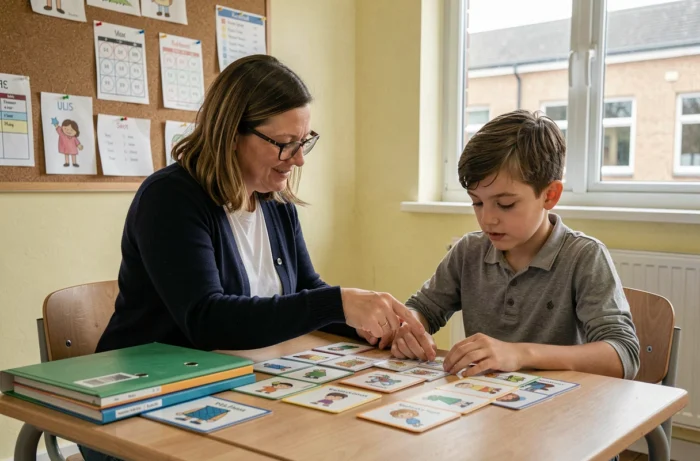
The personalized schooling plan (PPS) sets the framework, but the quality of inclusion for an autistic student depends on coordination between the ULIS program, the mainstream class and out-of-school care. Without a communication protocol linking these three settings, accommodations remain siloed and lose their consistency.
Continuity between ULIS, the mainstream class and out-of-school care for autistic students
The main risk for an autistic student enrolled in a ULIS program is fragmented support. The ULIS coordinator puts accommodations in place (visual aids, breaking instructions into steps, noise management), but these do not always follow the student into their mainstream class or into lunchtime and after-school care.
To ensure continuity, a practical communication document, separate from the PPS, is essential. It describes the strategies that work for the student: types of instructions (short, visual, written), noise tolerance threshold, transition routines and warning signs of sensory overload. This document is shared between the coordinator, the mainstream class teacher, the AESH and after-school care staff.
We have found that teams that formalize this handover reduce behavioral disruptions linked to transitions. The student has consistent points of reference in every setting, which reduces anxiety and helps prevent crises when moving from one place to another.
A detailed article on supporting autistic students in ULIS programs explains the practical strategies to use in this context.
The role of the ULIS coordinator in adapting support for autistic students
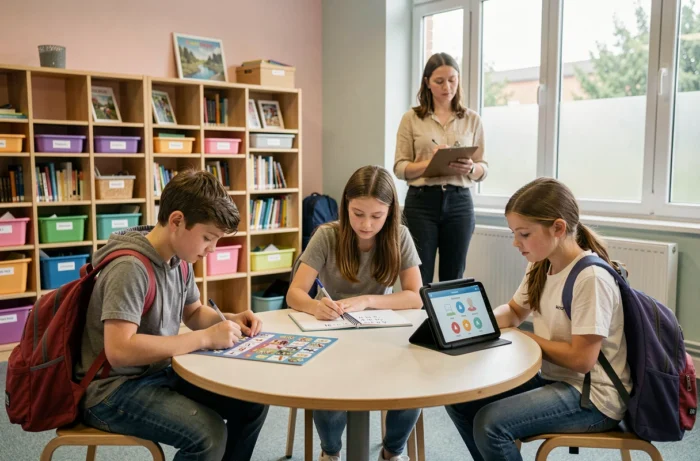
The ULIS coordinator is not a specialist teacher working in isolation. Their primary role is to organize inclusion in mainstream classes and prepare adapted teaching materials. For an autistic student, this involves specific work on making the timetable predictable and organizing the physical layout of the workspace.
In practice, the coordinator identifies the subjects in which inclusion in the mainstream class is appropriate, based on the student’s sensory and cognitive profile. A student with pronounced auditory hypersensitivity would not be placed in a group music lesson without prior preparation (noise-canceling headphones, a seat near the exit, a shorter session).
Coordination with the mainstream class teacher
The mainstream class teacher receives guidance from the coordinator on the accommodations to use: rephrasing instructions, allowing extra time and providing visual aids. A common risk is that these accommodations are seen as extra work rather than as a protocol integrated into classroom management.
Regular planning meetings between the coordinator and the mainstream class teacher are essential to ensure that inclusion means more than simply having the student physically present. The 2015 circular on ULIS programs provides for this time, but whether it is put into practice depends on how each school is organized.
AESH support for autistic students in ULIS: day-to-day responsibilities
An AESH (support worker for students with disabilities) provides assistance under a CDAPH notification, for a set number of hours. For an autistic student, the question is not just how many hours of support they receive, but what kind of support is provided.
- Support with sensory regulation: identify signs of overload (rocking, withdrawal, restlessness) and offer a temporary break in a quiet space identified in advance
- Communication support: rephrase the teacher’s spoken instructions as visual or step-by-step instructions, without doing the task for the student
- Social mediation: facilitate interactions with peers during informal times (recess, lunch) by guiding the student toward social situations suited to their tolerance level
- Reporting to the coordinator: share observations from day-to-day work (new behaviors, regression, progress) to update the communication document
The AESH does not decide on teaching accommodations. That is the responsibility of the coordinator and the teacher. The AESH implements the agreed support and observes how it works. In practice, this distinction is often unclear, leading to inconsistencies in the support provided.
Parents’ rights and options when support breaks down
The law of 11 February 2005 affirms the right to attend a mainstream school as close to home as possible, with a continuous and adapted educational pathway. Parents are involved in decisions about school placement and in drawing up the PPS. In practice, support can break down: an AESH is not replaced, inclusion time is reduced without consultation, or there is no coordinator trained in autism.
If the PPS is not being followed, parents can contact the local special educational needs coordinator, who liaises with the MDPH. If the situation continues, they can appeal to the DASEN. The CDAPH, which includes representatives of nonprofit organizations, remains the decision-making body for any changes to the student’s educational pathway.
Key points for families
- Check that the PPS explicitly covers out-of-school care and the related accommodations, not just classroom hours
- Ask for a copy of the practical communication document used by the ULIS team
- Attend school support review meetings (ESS) at least once a year, preparing a written list of points to discuss
A PPS that does not cover time outside the classroom leaves autistic students without appropriate support during lunch, after-school care or school trips. This gap is one of the main causes of unreported partial school exclusion.
Supporting an autistic student in a ULIS program does not happen in just one place or involve just one staff member. The quality of inclusion depends on the team’s ability to share information and maintain consistent points of reference across settings. When the communication document works, the student becomes more independent. When it is missing, every transition becomes a point of vulnerability.