Citroën structures its range around three types of engines: electric, hybrid, and thermal. Each technology meets a distinct use, and the choice depends as much on driving profile as on the regulatory constraints that evolve each year.
CO₂ Tax and Thermal Engines: What Changes in 2026 for Choosing Your Citroën
Before comparing models, one parameter conditions the actual cost of a thermal or non-rechargeable hybrid vehicle: the ecological tax. In 2026, the triggering threshold applies from 108 g of CO₂/km in the WLTP cycle, compared to 113 g the previous year.
This tightening has a direct consequence on the budget. A model that escaped the tax in 2025 may now be subject to it without any change in its technical specifications. During a visit to the dealership, the displayed price does not always reflect this additional cost: you need to check the approved emissions of the configured vehicle, including options.
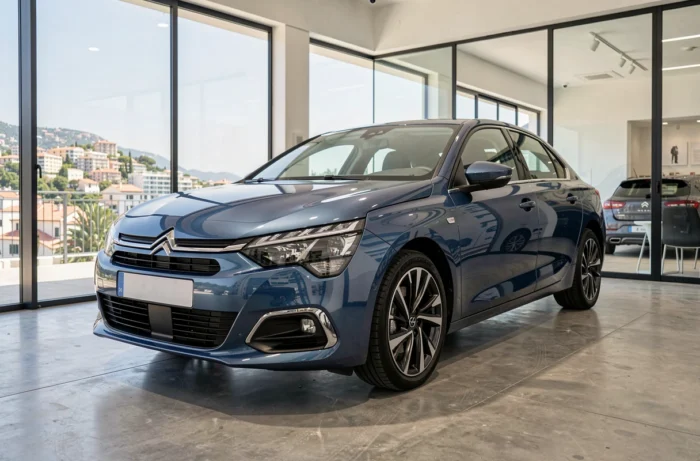
For the gasoline engines in the Citroën range (C3, C4, C5 Aircross), engine size and power directly influence the emission levels. The cars offered by Citroën Côte d’Azur allow you to compare the trim levels and available engines for each model, along with the associated emission data.
On the Côte d’Azur, where urban and suburban trips dominate, a vehicle below the tax threshold remains accessible in the range, provided you prioritize low-power versions or electrified engines.
WLTP Electric Range and Real Range: Reading Citroën’s Numbers Correctly
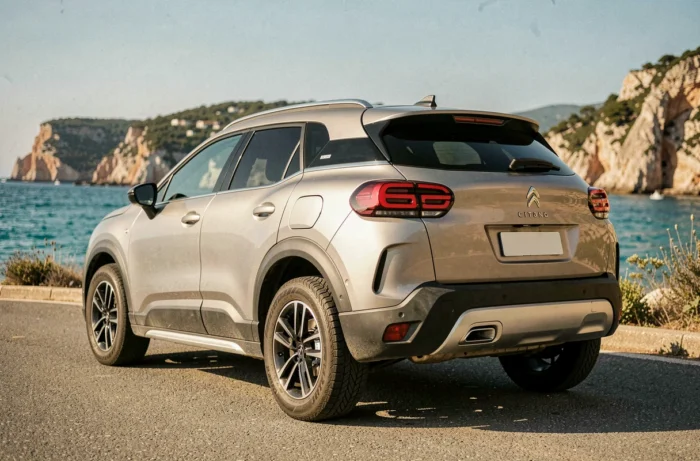
Citroën markets several models in 100% electric versions, identified by the prefix “ë”. The ë-C3 and ë-C3 Aircross boast up to 323 km and 397 km of WLTP range, respectively. These values correspond to the European homologation protocol, measured in a laboratory under standardized conditions.
The gap between homologated range and real range varies according to several factors:
- The topography of the route: hilly roads (Nice hinterland, coastal road) put more strain on the battery than a flat route
- The use of air conditioning, common on the Mediterranean coast, which can significantly reduce range in summer
- The driving style: frequent accelerations in the city or sustained speed on the highway consume more than the WLTP cycle simulates
The choice of battery capacity depends on daily mileage. For home-to-work commutes of a few dozen kilometers, an entry-level version is sufficient. For regular trips between coastal cities (Nice-Cannes, Antibes-Fréjus), a larger capacity battery offers a wider comfort margin.
Outdoor Trim on C3, C3 Aircross, and Ami: What the Name Really Hides
Unveiled in September 2026, the Outdoor trim line concerns three models: the C3, the C3 Aircross, and the Ami. The name evokes an adventurous use, but the technical reality is more nuanced.
The Outdoor trim does not turn these vehicles into off-roaders. The modifications are mainly aesthetic and functional: body protections, exterior personalization elements, and on the C3 Aircross, roof bars. Ground clearance, transmission, and off-road driving aids remain identical to other trims.
This distinction matters for a buyer on the Côte d’Azur. The roads in the hinterland (Mercantour, Roya Valley) are paved but winding. An Outdoor C3 Aircross navigates them without difficulty, but it does not replace an all-wheel-drive vehicle on unpaved tracks.
The electric versions of the Outdoor trim retain the same ranges as the standard trims. An ë-C3 Aircross Outdoor therefore displays the same 397 km WLTP as the classic version, with identical battery equipment.
Electric Vehicle Purchase Assistance in 2026: An Amount Varies by Household
The assistance for purchasing an electric car changed its mechanism in 2026. Its amount depends on the household profile and the manufacturer’s offer, meaning there is no longer a single guaranteed bonus regulated for all buyers.
Before finalizing the purchase of an ë-C3 or ë-C3 Aircross, it is necessary to simulate the amount the household can claim. Several online simulators, including those from energy suppliers and consumer advocacy sites, allow you to estimate the assistance based on income and the chosen model.
This parameter alters the balance between thermal and electric engines. For a model like the C3, available in gasoline and electric, the difference in list price can be significantly reduced by the assistance, making the electric version competitive in terms of total cost of ownership, especially for urban use where energy consumption remains low.
Citroën Range and Suspension Comfort: A Technical Choice Felt Daily
Citroën has historically built its reputation on suspension comfort. The Advanced Comfort technology, present on the C4, C4 X, and C5 Aircross, uses progressive hydraulic stops that filter out road imperfections.
On the road network of the Côte d’Azur, this technical choice has a concrete impact. The urban roads of Nice or Cannes feature frequent speed bumps and uneven surfaces. The departmental roads toward the hinterland alternate between tight turns and degraded sections. A well-calibrated suspension reduces fatigue on these routes.
The C5 Aircross, positioned as the family SUV in the range, offers the most generous suspension travel. The lower C4 favors a compromise between dynamism and filtering. Both models are available in plug-in hybrid versions, combining thermal and electric engines for mixed trips.
The renewal of the C5 Aircross introduces a new generation that maintains this comfort orientation while modernizing the platform. This model remains Citroën’s accessible high-end offering, with a price positioning below comparable German competitors.