
Taking lessons with a private tutor is not just about sitting in a living room and opening a notebook. The location, the format of the session, the preparation beforehand, and even the tax framework change depending on whether the lesson takes place at the student’s home, at the teacher’s place, or via videoconference. Understanding these modalities before starting avoids unpleasant surprises and allows you to make the most of each session.
Tax credit and lesson location: a distinction that few families anticipate
Did you think that all private lessons entitle you to the same tax benefit? The tax credit for personal services depends on the actual location of the session. Only lessons given at the student’s home are eligible, provided they are declared within the regulatory framework.
Sessions at the teacher’s location, in an external venue, or via videoconference do not fall under this scheme. A family alternating between in-person lessons at home and online must therefore separate the relevant hours in their documentation to declare only those that are truly eligible.
Another often overlooked point: for a self-employed teacher, simply registering their activity is not enough. They must also take a specific step with personal services so that their clients can benefit from the tax credit. This practical information about lessons with a tutor deserves to be checked before committing, as it directly influences the actual cost of the support.
The immediate advance system offered by Urssaf simplifies cash flow: after each session, the teacher or provider sends a payment request, and the family has 48 hours to validate it. Without a response within this timeframe, the request is automatically accepted.

Organization of a session with a private tutor: what changes compared to home
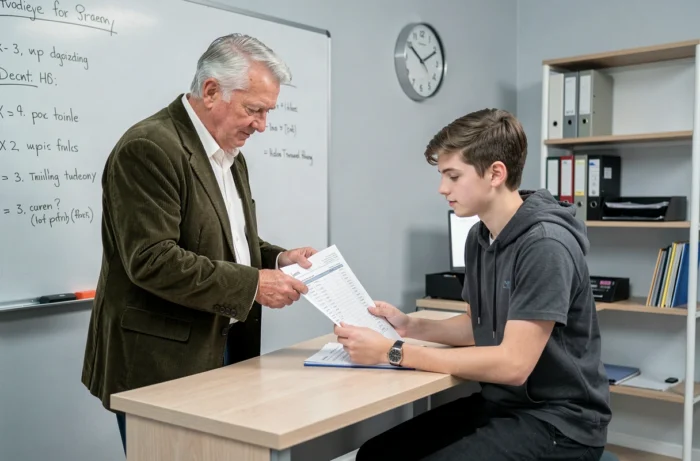
At the tutor’s place, the work environment is already set up. The teacher has their own teaching resources, board, and reference manuals. The student arrives in a setting designed for learning, which reduces setup time.
This configuration offers a concrete advantage for concentration. At home, distractions are numerous (phone, siblings, ambient noise). At the tutor’s, the environment is dedicated solely to schoolwork.
On the other hand, the travel costs fall to the family. Therefore, travel time must be integrated into the weekly schedule. For a middle or high school student, this also implies a certain autonomy in transportation.
Duration and frequency of sessions
The standard duration of a session ranges from one hour to one and a half hours. For elementary school students, shorter formats (45 minutes) work better: beyond that, concentration drops significantly.
The frequency depends on the goal. Regular weekly follow-up is suitable for consolidating fragile foundations. One session every two weeks may suffice for a student who simply needs methodology. It is better to have one well-prepared session per week than two rushed sessions.
Pedagogical preparation: what the teacher does before the session
An effective private lesson is not improvised. Preparation represents an invisible but crucial work time for the quality of the support.
- The teacher analyzes the student’s recent work (assignments, exercises, assessments) to identify specific gaps to address during the session.
- They prepare targeted exercises, often different from those in the school textbook, to approach the same concept from a new angle.
- They set a clear objective for the session: a skill to acquire, a method to master, a chapter to unlock.
This preparatory work partly explains the hourly rate charged. The billed time also covers preparation and follow-up between sessions, not just the hour spent with the student.
The student’s role in preparation
The student also has their share of responsibility. Bringing updated materials, signaling an upcoming assessment, mentioning a problematic chapter: these simple reflexes allow the teacher to adjust their program without wasting time at the beginning of the session.
Typical progression of a private lesson: the concrete phases
Each teacher has their own style, but most effective sessions follow a three-phase progression.
The lesson begins with a quick review of what has been done since the last session. The teacher checks whether the concepts worked on previously have been understood, often through two or three oral questions or a short exercise. This phase rarely lasts more than ten minutes.
Next comes the core of the session: the explanation of a new concept or an in-depth exploration of an identified difficulty. The teacher adapts their pace in real-time. If the student gets stuck, they rephrase, change the example, or propose a diagram. This immediate adaptability distinguishes private lessons from group teaching.
The session ends with independent practice. The student solves an exercise alone while the teacher observes their method. This moment reveals whether the concept is understood or if it needs to be revisited in the next session.
Choosing between lessons with the tutor, at home, or online
The choice of format depends on three concrete criteria:
- Tax eligibility: only home lessons allow for the tax credit, which can significantly reduce the cost.
- Family logistics: a tutor located near the school simplifies organization for an independent student, while home lessons avoid any travel.
- The student’s profile: some work better in an external environment, while others need the comfort of their desk to concentrate.
No format is universally better than another. A senior student preparing for an exam does not have the same needs as a struggling second grader with reading difficulties. The right format is the one that increases effective working time during the session, without the surrounding logistics becoming a hindrance.
Regularity matters more than location. Consistent support, with a teacher who knows the student’s academic journey and adjusts their sessions accordingly, produces visible results in a few weeks, regardless of the chosen format.