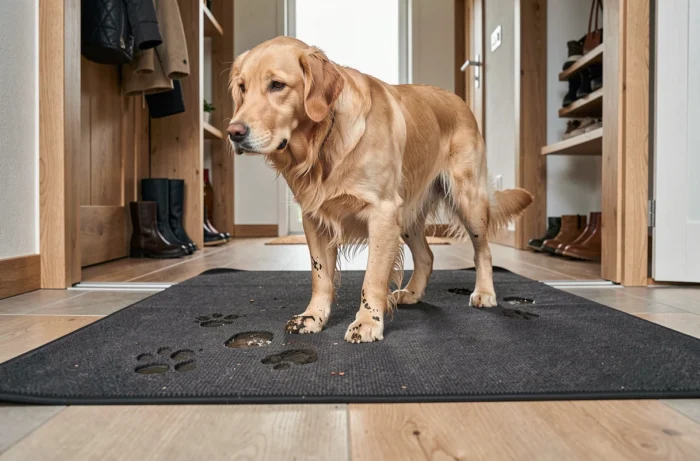
Choosing an absorbent dog paw mat means balancing three technical factors: the fiber’s absorbency, the weave’s durability, and how easy the mat is to wash. Each factor matters differently depending on where the mat will be placed and the size of the dog. This article compares the available materials, assesses their performance in different areas of the home, and highlights the differences that can justify one investment over another.
Comparing fibers for absorbent dog mats
The choice of fiber determines both how much water the mat retains and how long it lasts. Not all synthetic fibers perform equally, and some natural fibers can cause practical problems for pet owners.
| Fiber | Absorbency | Drying time | Machine washable | Scratch resistance | Main drawback |
|---|---|---|---|---|---|
| Polyester microfiber | High | Fast | Yes (low temperature) | Good | Traps hair on the surface |
| Polyamide (nylon) | Medium to high | Moderate | Yes | Very good | Higher price |
| Polypropylene | Low | Very fast | Yes | Good | Absorbs very little; water runs off the surface |
| Wool | Good (natural lanolin) | Slow | Rarely | Moderate | Long drying time; risk of odors if poorly ventilated |
| Jute / sisal | Low | Very slow | No | Fragile | Rots with repeated exposure to moisture |
Polyester microfiber offers the best balance of absorbency and drying time for everyday use with a dog. Polyamide is more durable than microfiber, which matters more for larger dogs whose claws exert greater pressure.
Polypropylene, often marketed as “practical,” absorbs virtually no water. Instead, water runs through to the underside of the mat. This material works as an outdoor doormat, but not as an indoor absorbent mat.
Wool retains moisture thanks to its protective lanolin. Its drawback is that it dries slowly, and when combined with rainwater brought in several times a day, this can create conditions that encourage unpleasant odors. Jute and sisal are best avoided: repeated exposure to moisture quickly degrades these plant fibers.
Choosing an absorbent dog paw mat means checking the actual fiber content on the label, as several products marketed as “ultra-absorbent” combine a microfiber top with a polypropylene underside and no waterproof layer in between.
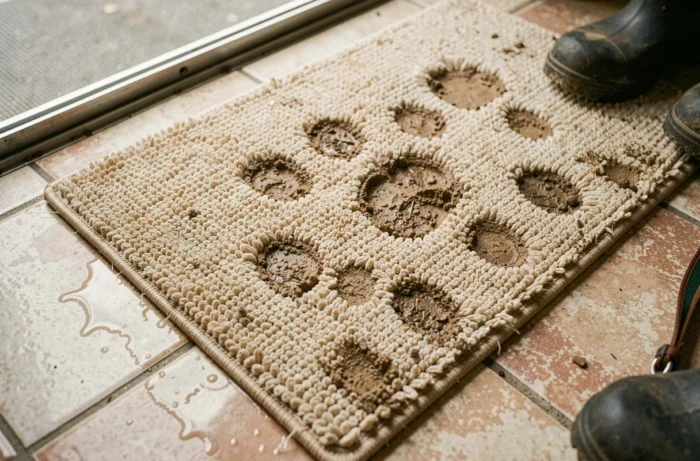
Where you use the mat and how large it is: where performance differences become clear
The same mat won’t perform equally well by the entrance, under a food bowl, or in a busy hallway. The location affects two factors: the type of mess (mud, water, food) and how often the mat is used.
Entrance and after walks
This is the most demanding area. Dogs bring in water and mud, and in winter, traces of salt or de-icing products. A mat alone is not enough to remove winter chemical residues: rinse your dog’s paws with clean water before they step on the mat to prevent them from licking these substances afterward.
An entrance mat works best as part of a two-step setup: an outdoor doormat to catch coarse dirt, followed by an indoor absorbent mat to soak up any remaining moisture. The mat should be large enough for the dog to stand on it with all four paws at once. Otherwise, the dog may track mud beyond the mat before it has finished drying its paws.
Food bowl area
Spills happen every day here. A feeding mat doesn’t need the same absorbency as a paw-drying mat, but it should have a waterproof layer on the underside to protect the floor from leaks. Models without this barrier let water seep through and can damage hardwood or laminate flooring.
Choosing the right size for your dog
A small dog can manage with a smaller mat. For a dog with broad paws and a heavier body, the area of contact with the floor is proportionally larger, and the amount of water carried in its coat increases. Choosing a mat that’s too small simply shifts the problem a few inches further on.
- For small dogs, an entrance mat twice the width of the front paws’ span is sufficient.
- For medium to large dogs, the mat should be at least as long as the dog’s body so the animal can stand on it completely.
- Under the food bowl, allow an overhang of at least one paw’s width on each side to catch splashes.
Caring for an absorbent mat: what “machine washable” doesn’t tell you
Most absorbent dog mats are labeled “machine washable.” That label can hide significant differences between products.
Wash temperature depends on the fiber and the manufacturer. Washing polyester microfiber at too high a temperature can damage the capillary structure that holds water. On the other hand, washing at too low a temperature may not remove bacteria that build up with repeated contact from wet paws.
Drying is the most overlooked step. Putting a damp mat back on the floor creates two problems: a slippery surface that can be dangerous for both dogs and people, and an environment where mold can grow between the mat and the floor. The mat must be completely dry before you put it back.
- Check the label for the maximum permitted wash temperature before the first wash.
- Avoid fabric softener, which clogs the microfibers and reduces absorbency over time.
- Air-dry the mat rather than using a tumble dryer, which can warp the non-slip backing.
- Keep a spare mat so you can rotate them while one is drying.
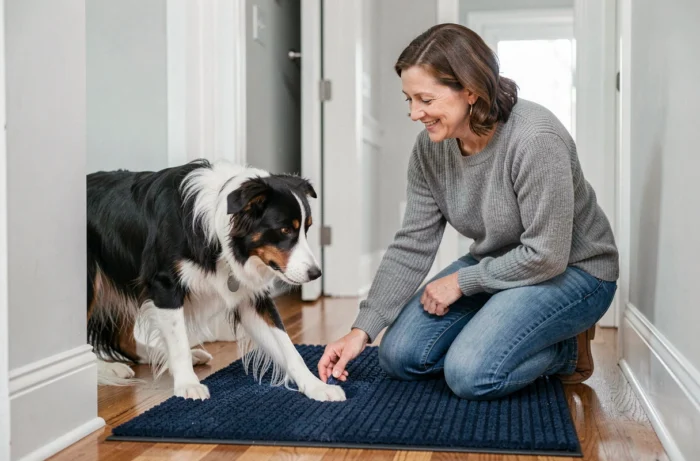
Color and texture: two criteria that are often poorly balanced
Color has no effect on absorbency, but it can dramatically change how often you feel the need to wash the mat. A light-colored mat shows every muddy mark after the first use. A mat that’s too dark can hide dirt so well that you forget to wash it, reducing its absorbency.
Mid-tone colors (gray, taupe, medium brown) offer the best balance between showing stains and fitting into your home. Heathered patterns hide hair better than solid colors.
As for texture, short, dense fibers are easier to clean than long ones. Long pile traps more dirt between the fibers, makes vacuuming harder, and takes longer to dry. For use with a dog, low-pile or short-loop textures consistently outperform shaggy styles.
An absorbent dog mat doesn’t have to be ugly to be practical. The most reliable way to choose one is to match the fiber to the intended location and to the care routine you’re willing to follow. A short-pile microfiber mat placed after an outdoor doormat, washed weekly, and dried flat will suit most situations without compromising the cleanliness of your home.