
The lawn seed market offers dozens of blends with brand names that promise hardiness, lush green growth or rapid germination. Behind these labels, compositions vary according to the grass species selected, their proportions and the conditions they are designed for.
The forthcoming European Plant Reproductive Material (PRM) Regulation could change how lawn varieties are assessed, including the announced removal of the official VATE evaluation, although the regulation is not yet in force. In this changing landscape, choosing a seed blend calls for closer scrutiny than simply reading the packaging.
Drought-resistant lawn seed: what the label doesn’t tell you
The words “drought-resistant” on a packet of lawn seed create a reasonable expectation: a lawn that survives summer without intensive watering. The reality is more nuanced. A drought-resistant blend needs regular watering while it establishes, even if it is designed to withstand water shortages once rooted.
The real benefit of these blends becomes apparent after several weeks of growth, once the root system has had time to establish itself deep in the soil. Until then, the seed needs consistent moisture to germinate, just like any other seed.
Another point worth considering is the blend’s exact composition. A product marketed as able to withstand unpredictable weather may combine tall fescue and ryegrass, but some manufacturers do not publish the exact proportions of each species. Without this information, it is difficult to compare products. Checking the list of grasses, their respective roles and the manufacturer’s watering recommendations remains the most reliable way to assess what you are actually buying.
Before settling on a single blend, it may be worth choosing lawn seed suited to each area of the garden rather than treating the whole lawn as one uniform space.
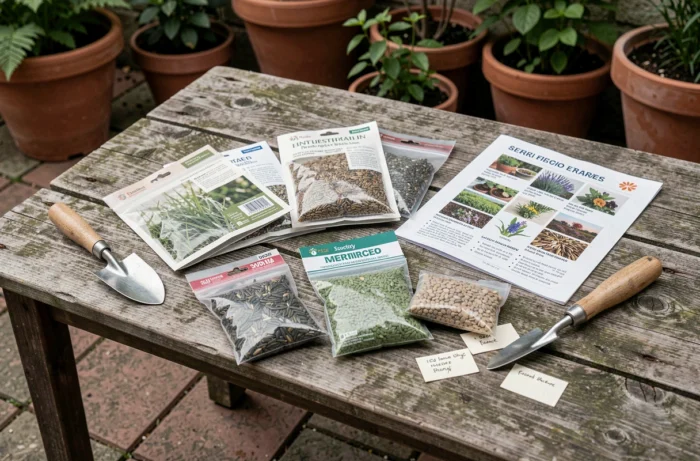
Lawn seed blends by area: match sowing to your garden’s conditions
A garden is rarely uniform. The path between the patio and the gate gets walked on every day. The base of a north-facing wall stays in shade for most of the day. A slope in full sun dries out within hours of rainfall.
Using a single blend across all these areas means accepting a constant compromise. Sowing different blends in different areas produces better results than relying on a supposedly all-purpose product.
High-traffic areas: choose ryegrass and tall fescue
Perennial ryegrass germinates quickly and tolerates frequent foot traffic. Combined with tall fescue, it forms a dense lawn that can recover after moderate wear. For garden paths or play areas, a blend with a high proportion of ryegrass is the best choice.
Shady areas: make creeping red fescue your first choice
Creeping red fescue tolerates limited sunlight and gradually spreads across the soil via its stolons. It is the go-to grass for areas that receive less than four hours of direct sunlight. Kentucky bluegrass can be added, provided the shade is not too dense.
Dry areas: consider alternatives to conventional lawn
For areas exposed to prolonged heat and subject to water restrictions, the best comparison is not always between two lawn seed blends. Ground covers such as kikuyu tolerate heat and foot traffic better than most conventional grasses.
Azorella is better suited to areas with little foot traffic. These alternatives have their own limitations: kikuyu is sensitive to cold, while azorella establishes slowly. But on a sunny slope that is rarely watered, they may be more realistic options than a lawn destined to turn yellow every summer.
Sowing and overseeding: why autumn makes a difference
The usual instinct is to sow in spring, as soon as temperatures rise. This time of year has one often-overlooked drawback: dry springs. When rain is slow to arrive in April or May, germination depends entirely on hand-watering, increasing water use and the risk of patchy growth.
Early autumn often offers more favourable conditions for sowing. Temperatures remain mild, rain returns and weed competition decreases. For overseeding a lawn damaged by summer, this window allows for more even establishment than spring sowing under water stress.
The soil still retains the warmth accumulated over the summer, which speeds up germination. The young shoots then have several months to take root before the heat returns the following year.

How to read the composition of a lawn seed blend
A seed packet label contains useful information, provided you know how to interpret it. Two details deserve particular attention:
- The grass species included and their respective proportions. A blend containing 80% ryegrass behaves differently from one dominated by tall fescue. Ryegrass establishes quickly, while fescue offers better long-term resistance to heat and wear.
- The intended use stated by the manufacturer. Categories such as “sports”, “ornamental” or “leisure” correspond to different compositions. An ornamental lawn prioritises fine-textured foliage over resistance to foot traffic.
- The recommended watering conditions, especially during establishment. A blend marketed as low-maintenance may need daily watering for several weeks before it can thrive without it.
When exact proportions are not shown on the packaging, the order in which the species are listed provides a clue: the first species named is generally the most abundant in the blend.
Lawn grasses and regulatory changes in Europe
The framework for assessing and marketing lawn seed in Europe could change in the coming years. The provisional agreement on the PRM Regulation provides for changes to the variety assessment process, including the removal of the VATE (Agronomic, Technological and Environmental Value) evaluation for certain categories.
The text has not yet been published or brought into force. Its implementation would be delayed. The practical implications for gardeners remain to be clarified: the way grass blends are tested and labelled could change, but the details will depend on the final version of the regulation.
For now, current French standards remain the benchmark when buying lawn seed. Checking that the product complies with current regulations and that the listed species suit the intended use of the garden remains the best way to make an informed choice, whatever blend you select.