
In 2021, Closer magazine published images suggesting that Sarah Knafo was pregnant. At the time, she was an adviser to Éric Zemmour, whose media profile was rising ahead of the presidential election. The publication was not accompanied by any official confirmation.
Yet within hours, the rumor had spread across social media, TV studios and news websites, before either of the people concerned had responded. This pattern of speculation preceding verified facts illustrates a recurring feature of media coverage of the private lives of French political figures.
Rumors and politicians’ private lives: what a press leak entails
A press leak is the disclosure of non-public information to the media, often by an anonymous or indirect source. In the case of a political figure, the leak may concern a professional, legal or personal matter. A leak does not imply that the information is true: it sets off an editorial cycle based on clues, not proof.
The celebrity-style coverage applied to political figures follows a specific pattern. Visual observations at public appearances (silhouette, clothing, posture) are interpreted as clues, then published in the form of a question. The question mark in the headline serves both a legal and an editorial purpose: it protects the outlet from accusations of making a false claim while generating traffic.
This pattern played out in Sarah Knafo’s case. Closer published photos and speculation without direct confirmation from her or her entourage. Looking back at the first leak about Sarah Knafo being pregnant, it is clear that the story was triggered by observation, not by a statement.
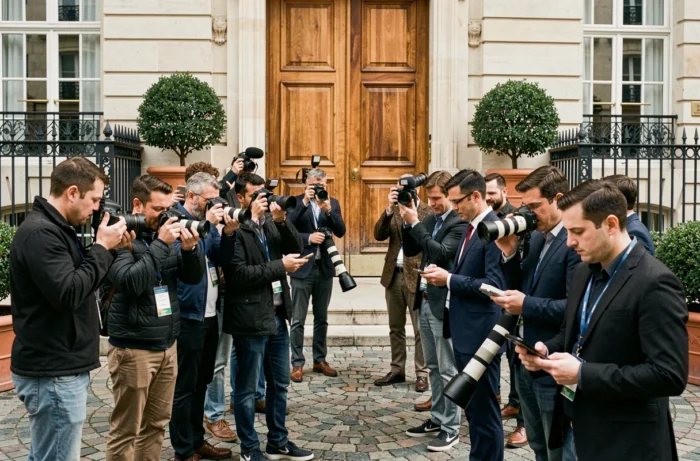
Closer’s initial report on Sarah Knafo’s pregnancy: context and timing
Closer’s report came during the pre-campaign phase of Éric Zemmour’s presidential bid. The timing was no coincidence. The timing of a celebrity press leak is driven by editorial calculations, with the subject’s growing profile ensuring maximum impact.
Sarah Knafo then held a dual role: political adviser and the candidate’s partner. This overlap made it easier for media coverage to shift from the political sphere to celebrity news. Celebrity magazines tend to focus on people whose visibility is rising rapidly, because audiences follow.
Sarah Knafo did not respond until later, leaving room for several days of speculation. According to her own words, as reported by the press, this period was “the worst moment of the campaign.” Some commentators interpreted the lack of an immediate denial, rightly or wrongly, as a form of implicit confirmation.
Why a delayed denial fuels rumors
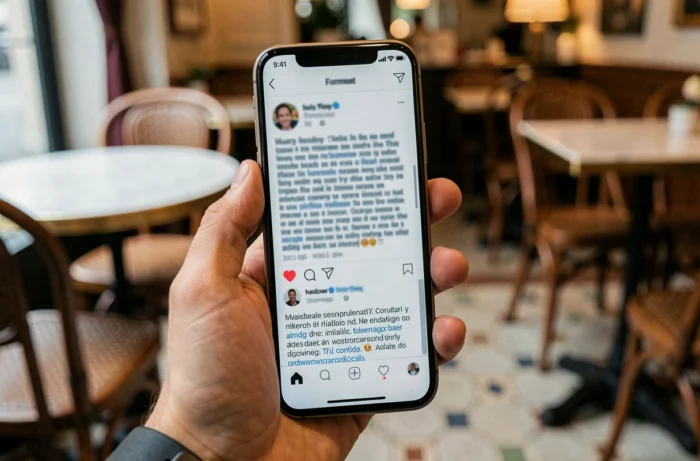
In today’s media cycle, silence is rarely seen as neutral. When a public figure does not respond in the first few hours after a leak, social media fills the gap with speculation. Every hour without a response generates new articles, tweets and reposts, increasing the visibility of the original rumor.
The process feeds on itself. One outlet picks up the question raised by Closer, another comments on that coverage, and a third analyzes “the controversy.” The original fact (a photo, a silhouette) disappears beneath successive layers of commentary. At that point, whether the claim is true becomes secondary: the debate itself becomes the news.
Amplification on social media: from rumor to virality
The shift from a press leak to a viral phenomenon relies on several distinct mechanisms that combine within hours:
- Accounts with large social media followings pick up the story and rephrase the question as a statement, removing the qualification in the original headline.
- Opposing political accounts share the rumor to undermine the credibility of the candidate or his adviser.
- Search engines index the story quickly, pushing the most widely shared content to the top and creating the impression of mass agreement as if it were collective confirmation.
Virality does not validate information; it makes it ubiquitous. This distinction, fundamental in theory, tends to disappear in practice for most readers who encounter the story through a news feed or notification.
In Sarah Knafo’s case, the rumor was also amplified by the tense political climate of the pre-campaign period. Both supporters and opponents of Éric Zemmour had reasons to spread the story, albeit for diametrically opposed reasons.
Women in politics, private lives and media coverage in France
The coverage of Sarah Knafo fits a broader pattern. Women associated with male political figures are framed in two ways: they are analyzed as political actors and scrutinized as celebrity figures. An actual or rumored pregnancy becomes a news story, whereas an equivalent matter involving a male politician would remain private.
This imbalance is not limited to magazines. Rolling news channels, general news websites and social media reproduce the same bias. The question “Is she pregnant?” asked about a political adviser has no male equivalent in French public debate.
The legal framework governing leaks about private life
Under French law, the right to privacy is protected by Article 9 of the Civil Code. Any publication concerning someone’s private life without their consent may lead to legal action. Sarah Knafo also said she had been “devastated” by the rumors, according to several press reports.
The difficulty lies in how this framework is applied in practice. Legal proceedings take a long time, and financial penalties are often modest compared with the advertising revenue generated by the article in question. The reputational damage caused by a leak is immediate; legal recourse comes months later.
As a trained magistrate, Sarah Knafo is familiar with these mechanisms. When she eventually responded publicly, she denied the pregnancy and condemned the intrusion into her private life. The episode remains a case study in how celebrity media can interfere with a presidential campaign, and in the limits of the law’s ability to protect privacy in the face of the speed of digital dissemination.