The European automotive sector is undergoing a period of rapid restructuring. With a regulatory framework under review in Brussels, electric vehicle registrations on the rise, and industrial regions weakened by changes to production chains, the market’s usual reference points are shifting all at once. Understanding the latest developments means untangling several threads: regulation, industrial structure, and the technological choices reshaping the automotive offering.
Environmental score and purchase incentives: an overlooked filter in the electric vehicle market
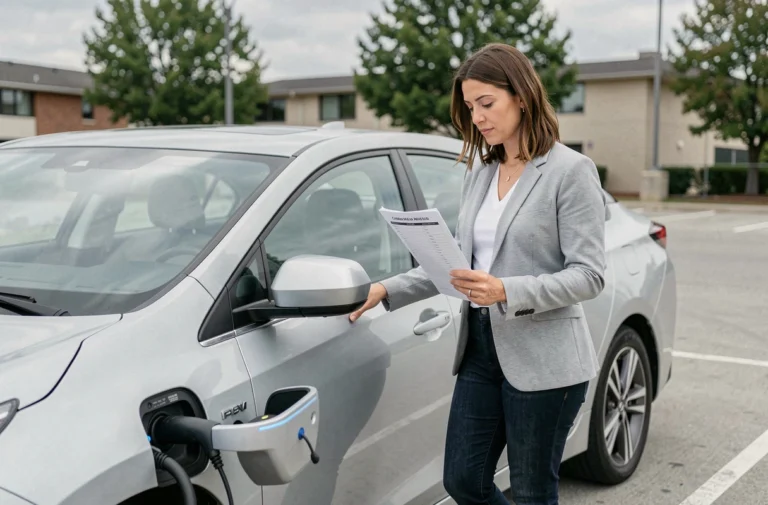
Public support for buying a new electric car in France is not limited to a single amount. The scheme varies depending on the household’s circumstances and the vehicle in question. A less visible criterion also determines access to incentives: the environmental score published by ADEME.
This score takes the vehicle’s production footprint into account, not just its powertrain or list price. ADEME publishes a list of eligible models based on this criterion. The social leasing scheme, designed for low-income households, also takes it into account. In other words, an electric vehicle is not automatically eligible for incentives.
This mechanism influences automakers’ choices as much as buyers’. A model assembled far from its sales market, using components with a high carbon footprint, may be excluded from the scheme. To keep up with these developments and their practical impact on the market, Veridictus’s automotive section regularly details the eligibility requirements for incentives and the models covered.

European emissions regulations: where the legislative process stands
The European Commission has proposed revising CO2 emissions standards for new light-duty vehicles. The proposal is still making its way through the European Parliament and the Council.
The regulation has not yet been adopted in its final form. Discussions are focused on thresholds, deadlines, and any flexibility granted to automakers. The gap between the initial proposal and the final text could substantially change the obligations facing companies in the sector.
This regulatory uncertainty weighs on investment decisions. An automaker committing several billion to an electric platform needs clarity on market rules over the next ten years. Suppliers, whose product development cycles are long, face the same pressure.
What the legislative timetable means (or doesn’t mean) for automakers
Until the text is passed, automakers are planning around different scenarios. Some are accelerating their transition to electric vehicles in anticipation of strict standards. Others are maintaining investment in hybrids, believing the final text will leave them room to maneuver. The lack of a definitive framework is creating two parallel industrial strategies, with consequences for employment and production at European factories.
Suppliers and industrial regions: the hidden side of the transition
The challenges of the automotive transition are not reflected solely in the results of major automakers. Suppliers, often based in specialized industrial regions, bear a significant share of the risk.
In 2023, only a limited share of suppliers were involved in designing hybrid or electric vehicles. Many remain heavily dependent on the conventional combustion-engine supply chain. Their transition requires investment in research and development, training, and new production equipment—costs not every company can absorb.
- Suppliers specializing in combustion-engine components (cylinder heads, fuel injection systems, exhaust systems) are losing business without being able to quickly reposition themselves in the electric vehicle market.
- Employment regions affected by these changes sometimes have several thousand jobs tied to a single major customer, amplifying the impact of a drop in orders.
- Skills management is becoming a major challenge: expertise in traditional mechanics does not translate directly into proficiency in batteries or onboard electronic systems.
The vulnerability of suppliers dependent on combustion engines receives little attention when analysis is limited to major automakers.
Heavy-duty vehicles and commercial fleets: a distinct technological challenge
The shift to electric passenger cars attracts media attention. The transition for heavy commercial vehicles (trucks, buses, and coaches) raises a different set of challenges.
Recent data show that sales of electric and plug-in hybrid trucks and buses remain modest in Europe. Range, charging time, and payload constraints limit the replacement of diesel fleets.
Why solutions for cars don’t work for heavy-duty vehicles
A long-haul truck travels several hundred kilometers a day carrying a load of several dozen tonnes. Current batteries require a trade-off between onboard weight and range, reducing payload capacity. Research needs for heavy-duty vehicles differ fundamentally from those for cars.
Hydrogen is sometimes presented as an alternative for this segment. However, distribution infrastructure remains in its infancy, and the cost of producing green hydrogen is still high. Innovation in this area is progressing, but not yet fast enough to enable large-scale deployment across commercial fleets.
European registrations: what the latest figures reveal
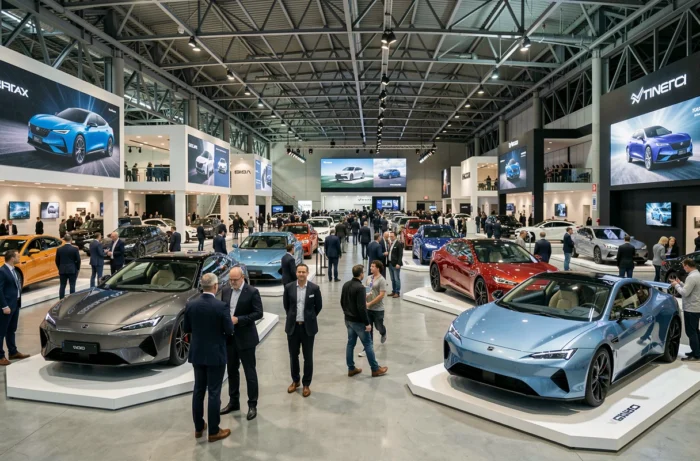
New car registrations in Europe have increased over the past few quarters, and the share of battery electric vehicles continues to grow. European automotive demand remained strong in the third quarter.
These aggregate figures mask differences between countries and segments. Electric vehicle growth is concentrated in markets where public incentives remain generous and charging networks are extensive. In countries where these conditions are not in place, combustion-engine and hybrid vehicles retain a dominant position.
The European automotive market is therefore growing, but unevenly. The transition is not following a uniform path from one country to another, making industrial planning more complex for automakers operating across multiple markets. The coming months, as the European regulatory framework is finalized and national incentive schemes evolve, will determine whether this momentum accelerates or becomes even more fragmented.