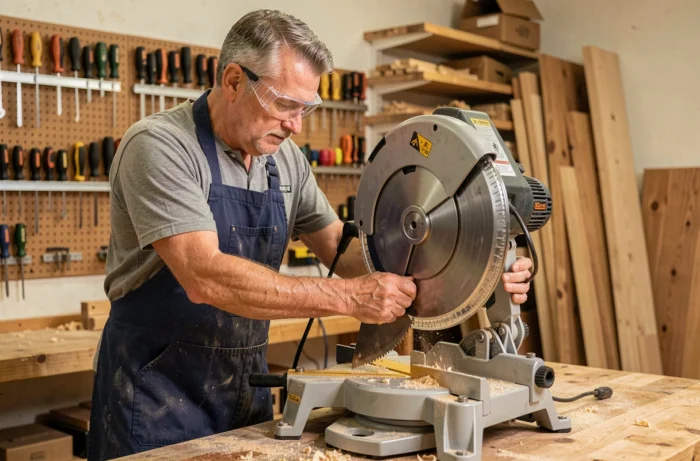
A mitre saw should be chosen as much for dust management and workshop space as for the cutting width listed in the specifications. Wood dust is classified as a known carcinogen by the IARC, and the INRS recommends capturing it as close to the source as possible. An integrated dust bag is no substitute for an extractor connected to the machine. This factor, rarely decisive in buying guides, nevertheless determines whether the tool is practical for everyday use.
Wood dust extraction and workshop constraints
Most product specifications mention a dust extraction port without stating its diameter or the minimum airflow required. In an enclosed or semi-open workshop, the fine dust generated by repeated cuts with a mitre saw far exceeds what a collection bag can filter.
A workshop vacuum connected directly to the blade guard remains the only truly effective way to keep exposure below recommended limits. Before buying, check that the machine’s dust port diameter is compatible with your existing extraction system.
Dust extraction is a selection criterion, not an optional accessory. If your workshop does not have a suitable vacuum, include its cost in the machine’s total budget. A detailed comparison of models and their extraction setups is available at https://www.scie-radiale.net, which also lists technical specifications by product range.
Available space matters just as much as extraction airflow. A sliding mitre saw needs clearance behind it, which many small workshops cannot provide. Some manufacturers offer dual-rail systems on bearings that reduce the installation depth, but measure the actual footprint before placing your order.
Guidance and real-world accuracy when making mitre cuts
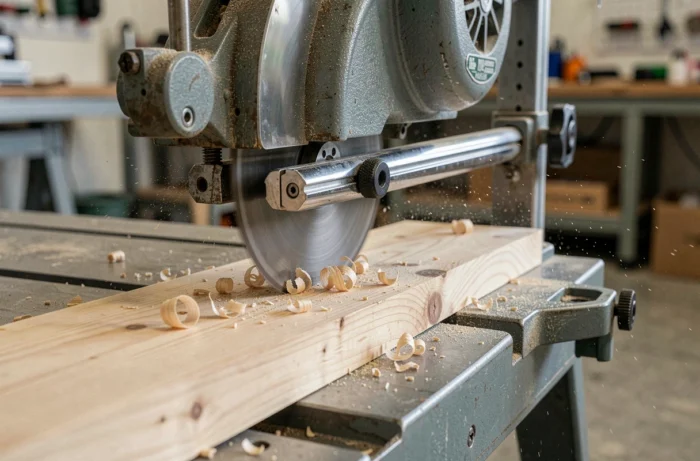
Published cutting capacities (maximum angle, width and thickness) are not enough to assess accuracy in real-world use. Imprecise sliding along the rails creates lateral play, resulting in slightly bowed or misaligned cuts that become apparent as soon as you assemble the pieces.
Dual rails on bearings improve sliding stability compared with smooth-bar systems. This design detail makes a measurable difference on compound mitre cuts, where even the slightest play compounds across the bevel and table rotation.
The alignment of the stops is also worth checking. On some entry-level models, the angle stop has play that makes fine adjustments tedious. We recommend testing a 45° cut on a hardwood offcut before committing to a purchase, rather than relying solely on the catalogue specifications.
What to check on the machine
- Lateral play in the rails at the end of their travel, with the blade lowered, by applying light sideways pressure to the cutting head.
- Angle-stop repeatability: return it to 0° after setting it to 45° and check that the pointer lines up exactly with the mark.
- The bevel lock: if it is not tightened enough, the head can drift as it comes down.
- The flatness of the cutting table, which you can check by laying a metal straightedge across it.
Mitre saw or table saw: the limits of each machine for different types of cut
A mitre saw is not suitable for every workpiece size. It excels at crosscutting boards and beams to width and thickness, making mitre cuts or straight cuts on boards, skirting boards and rafters. When it comes to ripping a long board lengthwise, a table saw is more suitable than a mitre saw.
This distinction may seem obvious, but it explains many unsuitable purchases. A woodworker who mainly cuts panels or battens lengthwise does not need a mitre saw. By contrast, for a carpenter or flooring installer who crosscuts a variety of stock at different angles, the mitre saw is the workshop’s central tool.
The choice therefore depends on the type of cut that features most often in your projects, not on the machine’s theoretical versatility.
Blade, power and multi-material options: what really matters for woodworking
Some newer models come with a single blade advertised as suitable for wood, metal and plastic. If wood is your main material, a dedicated blade still delivers a better cut. Multi-material blades compromise on tooth geometry, resulting in a less clean finish on hardwoods and melamine-faced panels.
When it comes to power, the useful measure is the ability to maintain rotational speed under load, not the rated wattage. A modestly powered motor well matched to a 216 mm blade will deliver more consistent results than a powerful motor paired with a 305 mm blade and a poor transmission.
Blade criteria for woodworking
- Tooth count: above 60 teeth on a 216 mm blade, the cut is finer, but you need to feed the material more slowly to avoid scorching.
- Tooth geometry (ATB, TCG): alternate-top-bevel (ATB) teeth are suitable for clean crosscuts in solid wood and panels.
- Kerf width: a thin-kerf blade reduces motor strain and the amount of dust produced, which also helps with extraction.
The development of cordless models is worth watching. Recent mitre saws pair a brushless motor with platform batteries and direct connectivity to a vacuum. Weight is still worth checking: these machines are often heavier than their corded equivalents, which can be an issue for job-site use. Also check whether the model is sold as a “bare tool” (without a battery or charger), as the extra cost of batteries can dramatically change the final budget.
Choosing a mitre saw comes down to three practical questions: what type of cut you make most often, how much space and dust extraction your workshop can actually provide, and which blade suits the materials you typically work with. Maximum cutting capacity comes after these considerations, not before.