
The verb choisir conjugated in the passé simple has forms that, in all three singular persons, look identical to the present indicative. This grammatical homonymy creates a practical problem: how can you tell je choisis (present) from je choisis (passé simple) without any additional clues? The issue matters less in spoken French, where this tense has all but disappeared, than when reading literary narratives or other storytelling texts.
Passé simple and present forms of choisir: a table illustrating the homonymy
The second conjugation group follows a regular pattern in the passé simple, with the stem chois- followed by endings containing -i-. The tricky part is the singular, where the forms are exactly the same as in the present.
| Person | Present | Passé simple | Identical form? |
|---|---|---|---|
| je | choisis | choisis | Yes |
| tu | choisis | choisis | Yes |
| il/elle | choisit | choisit | Yes |
| nous | choisissons | choisîmes | No |
| vous | choisissez | choisîtes | No |
| ils/elles | choisissent | choisirent | No |
In the plural, the difference is immediately clear. The passé simple drops the -iss- infix found in other tenses. You write nous choisîmes, never nous choisissîmes. Likewise, ils choisirent replaces ils choisissèrent, a form that does not exist.
An article detailing the forms of the verb choisir in the passé simple confirms this regular pattern for the second conjugation group, shared by finir, réussir, and grandir.
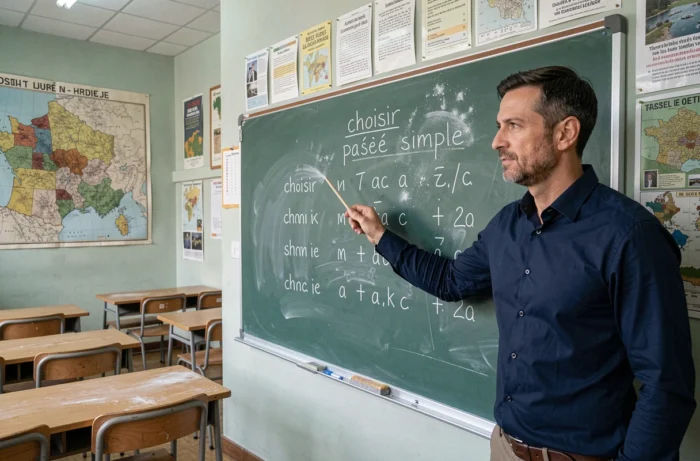
Disambiguating choisir in the passé simple through narrative context
In the sentence Il choisit de partir, nothing in the verb’s morphology tells you whether it is the present or the passé simple. Only time markers and the tense pattern of the surrounding verbs resolve the ambiguity.
Explicit time markers
A time expression referring to the past immediately points the reader toward one interpretation. Ce jour-là, il choisit de partir places the action in a past narrative. Aujourd’hui, il choisit de partir places it in the present.
Expressions such as en 1940, à cet instant, and un matin de novembre serve as signposts. Without them, the reader must rely on a second clue: the tense of nearby verbs.
Agreement with the surrounding verbs
In a paragraph where the other verbs are in the passé simple (il entra, regarda la salle et choisit une place au fond), there is no longer any doubt. The narrative’s verb tense pattern requires a past-tense reading. The verb choisir is ambiguous on its own, but not when it is part of a narrative sequence.
This explains why learners mainly need to recognize the passé simple when reading. In everyday conversation, it is replaced by the passé composé (j’ai choisi). The passé simple belongs to literary and journalistic writing.
Conjugating choisir in the passé simple: three common points of confusion
Errors are not usually about memorizing the six relatively simple forms, but about confusion with other tenses or moods.
Confusion with the inflected past participle
The passé simple never agrees in gender. In the passé simple, you write elle choisit, with no final -e. The form choisie appears only as a past participle in a compound tense: elle a choisi, la robe choisie par Marie. Adding an -e to choisit in the passé simple is a common mistake, because the analogy with the past participle is tempting.
Confusion with the imperfect subjunctive
The third-person singular of the imperfect subjunctive takes a circumflex accent: qu’il choisît. This form differs from il choisit (passé simple, without an accent) by just one diacritic. In practice, the imperfect subjunctive has become rare. It survives in literary constructions such as il fallait qu’il choisît.
- Passé simple: il choisit (no accent) — tense used for past narration
- Imperfect subjunctive: qu’il choisît (circumflex over the î) — mood used in subordinate clauses in formal contexts
- Present indicative: il choisit (no accent) — graphically identical to the passé simple
Inventing nonexistent plural forms
The most mechanical mistake is to copy the present-tense plural into the passé simple. This produces forms such as nous choisissions (which is actually an imperfect form) or ils choisissèrent (which does not exist). In the passé simple, the stem remains chois- without the -iss- infix in the plural: nous choisîmes, vous choisîtes, ils choisirent.

Recognizing choisir in the passé simple when reading: the skill that really matters
The passé simple has disappeared from spoken contemporary French. Native speakers use the passé composé (j’ai choisi) in everyday situations. However, anyone who reads novels, short stories, history books, or narrative journalism regularly encounters forms such as il choisit and ils choisirent.
For learners of French as a foreign language and French-speaking students alike, the priority is to recognize these forms, not to produce them spontaneously. A reader who identifies choisirent as a passé simple understands that the action is completed and occurred at a specific point in time, which is enough to follow the story.
The verb choisir follows the perfectly regular second-group pattern in the passé simple. The endings (-is, -is, -it, -îmes, -îtes, -irent) are exactly the same for finir, réussir, agir, and réfléchir. Mastering one of these verbs means mastering the entire group. The real challenge is distinguishing the present from the passé simple in the singular through context, and remembering never to make this tense agree in gender.